
Mileage and Car Insurance in the UK

Mileage and Car Insurance in the UK
In simple terms, the more time a car spends driving, the more chances there are for something to go wrong. That does not mean high mileage always leads to high premiums, but it does mean mileage is one of the details insurers take seriously.
Some policies are designed for drivers who do relatively few miles each year. These are often described as limited mileage policies. They can suit cars used occasionally rather than daily, or second cars that spend more time on the drive than on the road.
Why insurers ask for an annual mileage estimate
Most policies are priced using an estimate of how many miles the car will cover over the next 12 months. That figure helps build a picture of day-to-day use. A car used for short local trips a few times a week may be seen differently from one doing long motorway runs every day, even if both are driven carefully.
Nobody gets to January and somehow knows exactly what November will look like. Jobs change. Routines change. Families change. A car that was mainly used for shopping and local errands can suddenly become a commuter car. It happens. It is only an estimate, of course.
How mileage can affect the premium
Higher mileage often means a higher premium because the car is exposed to more risk over the year. More miles usually mean more junctions, more parked cars, more wet mornings, more dark winter journeys, more chances for a scrape or bump. That is the broad idea.
That said, insurers do not look at mileage in isolation. A driver covering a fair number of miles on familiar main roads may be viewed differently from someone doing fewer miles entirely in busy urban traffic. Mileage is part of the picture, not the whole picture.
Why accuracy matters
That can be a mistake. If the mileage declared on the policy is clearly unrealistic, or turns out to be well below the car’s actual use, the insurer may ask questions if there is a claim. They may also decide the premium was based on the wrong information. It is tempting to guess low and hope for the best.
That does not mean being a few hundred miles out will bring the roof down. Estimates are estimates. What matters is that the figure is honest and reasonably sensible when the policy is taken out.
Working out a sensible mileage figure
A practical way to estimate annual mileage is to think about regular journeys first. Commuting, school runs, shopping, visiting family, weekend trips, and holidays all add up. It is often easier to calculate a typical week, then multiply it across the year and add a bit for the unexpected.
If the car has done a similar pattern of use in the past, old MOT records can help as well. They are not perfect, but they do give a rough guide. Better that than plucking a number out of thin air and hoping it sounds modest.
What limited mileage cover usually means
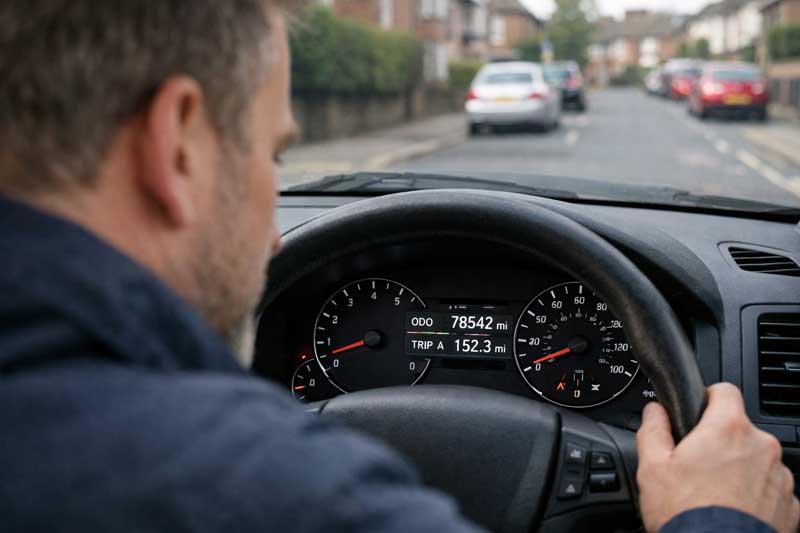
The catch is fairly obvious: the mileage limit needs to fit the way the car is actually used. If the allowance is too tight, the policy can become awkward before the year is out. A low-mileage policy only makes sense if the figure is realistic from the start.
Can reducing mileage lower the cost?
Sometimes it can. And the revised figure better matches real use, the insurer may see that as lower risk if the car is genuinely used less. But this is not a magic lever to pull every renewal. A policy does not become cheaper simply because a driver chooses a smaller number on a form.
Have retired, or now use the car mainly for short local journeys, that is one thing if mileage has fallen because you work from home more often. That is another if the number is reduced on paper while the car is still doing the same miles. The key word is genuinely.
When to update your insurer
If your mileage changes noticeably during the policy year, it is sensible to tell the insurer. That is especially true where use has increased beyond what was originally declared. A new job, longer commute, regular hospital visits, or frequent trips to care for family can all push mileage up more quickly than expected.
It can also be worth updating the insurer if mileage has dropped sharply, though any reduction in premium is not guaranteed. Even so, it keeps the policy details accurate, and that is usually the safer place to be.
Low mileage does not always mean low risk
One small wrinkle: low mileage is not always automatically seen as safer. A driver who rarely uses the car may be less familiar with it, less confident in poor conditions, or more likely to make only short trips in congested areas. Insurers know that. So while mileage matters, it sits alongside other details such as postcode, age, car type, occupation, claims history, and where the car is kept overnight.
Keeping the figure sensible
The best approach is usually the plainest one. Give a mileage estimate that reflects how the car is actually used, review it at renewal, and update the insurer if things change materially during the year. It is not glamorous. Still, it can save a lot of bother later.
In practice, get the mileage badly wrong and you risk arguments when you least want them. Get it roughly right and the policy stands on much firmer ground. That is the real value of it.
Estimating annual mileage
Give a realistic estimate based on normal commuting, work and private journeys. It does not need to predict the exact final mileage, but deliberately understating it to obtain a cheaper quote can create problems.
Low-mileage and occasional-use cars
Drivers who use a car rarely can sometimes benefit from low-mileage or limited-mileage policies, but the cheapest option depends on the insurer. Very low use does not remove theft, fire or other risks while the car is parked.
Updating mileage
If your driving pattern changes substantially during the policy, tell the insurer where the policy requires it. A new job or long commute can make the original estimate unrealistic.